
Insomnia
Sleep difficulty that goes beyond a bad night.
What is Insomnia?
Insomnia is characterized by persistent difficulty falling asleep, staying asleep or waking too early – resulting in sleep that is insufficient, unrefreshing or both. To meet the clinical threshold for insomnia disorder these difficulties must occur at least three nights per week, persist for at least three months and cause significant daytime impairment despite adequate opportunity for sleep.
Insomnia is not simply a sleep problem. It is a 24-hour condition. The arousal, anxiety and cognitive activity that drive insomnia at night are present throughout the day – shaping how a person thinks about sleep, how they behave in relation to it and how their nervous system responds when sleep is attempted. Understanding this is fundamental to effective treatment.
Insomnia is one of the most common health complaints and one of the most undertreated. Many people live with chronic insomnia for years – relying on sleep medication, alcohol or other short-term strategies that provide temporary relief without addressing the underlying mechanisms maintaining the problem. At Karasick Psychology we provide evidence-based psychological treatment for insomnia that produces lasting improvement without medication.

Types of Insomnia
Sleep Onset Insomnia
Difficulty falling asleep at the beginning of the night. Characterised by lying awake for extended periods, a racing mind that will not switch off and increasing frustration and anxiety as time passes. Often driven by hyperarousal and conditioned arousal to the bed and bedroom environment.
Sleep Maintenance Insomnia
Difficulty staying asleep through the night — waking frequently or for extended periods during the night and struggling to return to sleep. Often associated with anxiety, depression, chronic pain, hormonal changes or other medical conditions that disrupt sleep continuity.
Early Morning Waking
Waking significantly earlier than intended and being unable to return to sleep. Particularly common in depression and in older adults. Results in significantly reduced total sleep time and daytime fatigue even when falling and staying asleep is not problematic.
Comorbid Insomnia
Insomnia occurring alongside another condition — including anxiety, depression, PTSD, chronic pain, ADHD or a medical condition. Comorbid insomnia was historically treated as secondary to the primary condition — research now shows it requires direct treatment in its own right, as it maintains and worsens the conditions it co-occurs with.
Psychophysiological Insomnia
Insomnia driven by conditioned arousal — where the bed, bedroom and bedtime routine have become associated with wakefulness and anxiety rather than sleep. The person may be able to fall asleep easily in other environments but becomes hyperaroused in their own bedroom. A common and highly treatable presentation.
Paradoxical Insomnia
A presentation where the person reports significantly more wakefulness than objective sleep monitoring shows. The experience of poor sleep is real and distressing — but the actual sleep obtained is closer to normal than perceived. Addresses through cognitive work targeting sleep misperception and sleep-related anxiety.
Does this sound familiar?
▪ Lying awake for extended periods despite feeling tired
▪ Waking during the night and struggling to return to sleep
▪ Waking earlier than intended and being unable to get back to sleep
▪ A racing or overactive mind at bedtime that will not switch off
▪ Dreading bedtime because of the anxiety and frustration associated with sleep
▪ Daytime fatigue, cognitive impairment or mood disturbance as a result of poor sleep
▪ Relying on alcohol, sleep medication or other strategies that are not producing lasting improvement
▪ Spending excessive time in bed in an attempt to get more sleep – which often makes things worse
▪ Significant preoccupation with sleep and its effects throughout the day
▪ Insomnia that has persisted for months or years despite attempts to address it
Why insomnia persists
Insomnia rarely continues because of the original trigger. Once sleep is disrupted the behaviours and thought patterns that develop in response — spending more time in bed, worrying about sleep, avoiding activities out of fatigue – create a self-sustaining cycle that persists long after the original cause has resolved. Understanding what is keeping insomnia going is the foundation of effective treatment.
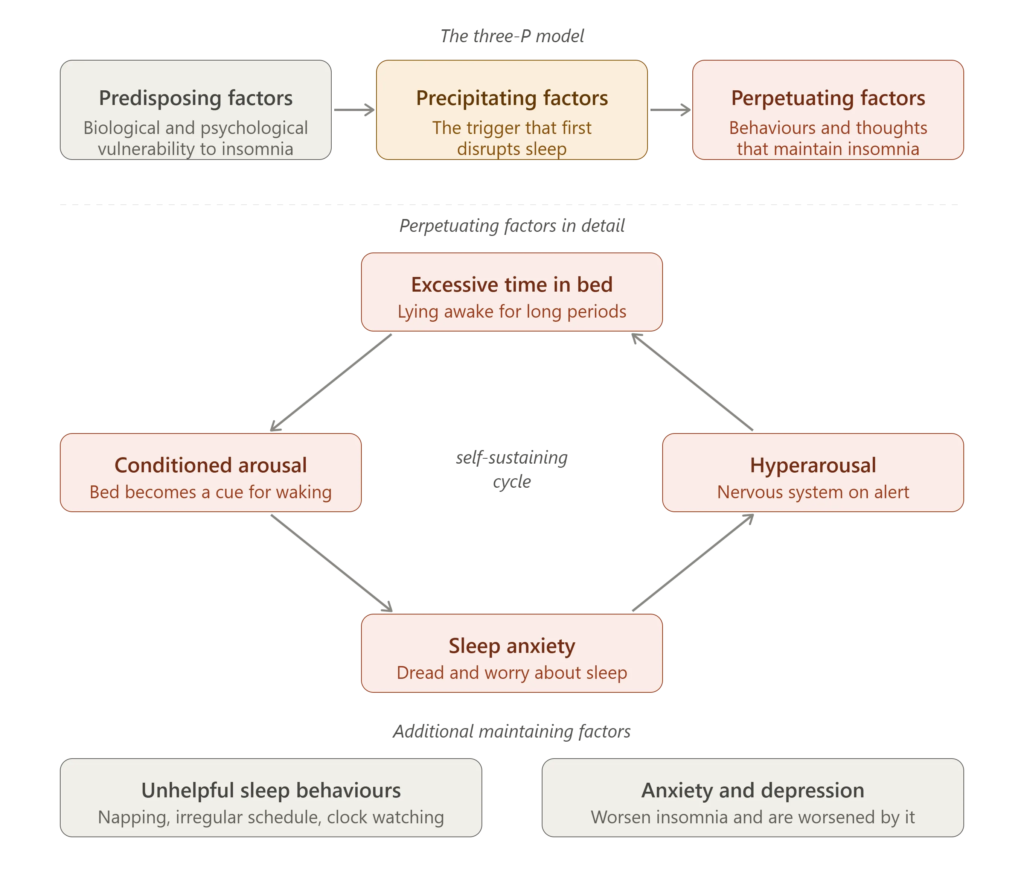
Insomnia is maintained by a predictable set of psychological and behavioural factors – understanding these is essential to effective treatment. The three-P model describes how insomnia develops and persists through predisposing factors (biological and psychological vulnerabilities), precipitating factors (the trigger that first disrupts sleep) and perpetuating factors (the behaviours and thought patterns that maintain insomnia long after the original trigger has resolved).
Perpetuating factors are what keep insomnia going. They include spending excessive time in bed, irregular sleep schedules, daytime napping, using the bed for activities other than sleep, clock watching, catastrophic thinking about the consequences of poor sleep and the conditioned arousal that develops when the bed becomes associated with wakefulness rather than sleep.
Body: Anxiety and depression are both causes and consequences of insomnia. Poor sleep worsens mood and cognitive functioning — which in turn increases anxiety and depression — which further disrupts sleep. Breaking this cycle requires targeted treatment of both the insomnia and the underlying psychological factors maintaining it.
Treatment
CBT-I — the gold standard treatment for insomnia.
Cognitive Behavioural Therapy for Insomnia (CBT-I) is the most effective treatment for chronic insomnia – recommended as the first-line treatment over sleep medication by sleep medicine guidelines internationally. Unlike medication CBT-I addresses the underlying mechanisms maintaining insomnia rather than temporarily suppressing symptoms. The improvements produced by CBT-I are durable – maintained and often continuing to improve after treatment ends.
CBT-I at Karasick Psychology includes sleep restriction therapy, stimulus control, sleep hygiene, relaxation training and cognitive restructuring targeting the beliefs and thought patterns that maintain hyperarousal and sleep-related anxiety. Treatment is structured, evidence-based and typically delivered over 6 to 8 sessions.
For insomnia occurring alongside anxiety, depression, chronic pain or other conditions treatment addresses both the insomnia and the contributing conditions – not one at the expense of the other. Treating insomnia directly in the context of comorbid conditions produces better outcomes for both the insomnia and the co-occurring condition.
What to expect
Treatment begins with a thorough assessment of your sleep history, sleep patterns and the factors maintaining your insomnia. You will be asked to complete a sleep diary before and during treatment to provide the data needed to guide the intervention precisely. From there treatment is structured, collaborative and focused on producing lasting improvement in your sleep.