
Social Anxiety
More than shyness — a clinical condition that shapes daily life.
What is Social Anxiety Disorder?
Social Anxiety Disorder — also known as social phobia — is characterised by intense, persistent fear of social situations in which the person may be scrutinised, judged or humiliated by others. It goes far beyond shyness or introversion. Social anxiety is a clinical condition that significantly impairs daily functioning — affecting relationships, academic and occupational performance and quality of life.
The core fear in social anxiety is negative evaluation — the belief that others are constantly judging, criticising or forming negative impressions. This fear triggers significant anxiety before, during and after social situations — and drives avoidance that gradually restricts life further and further. The avoidance provides short-term relief but maintains and strengthens the anxiety over time.
Social anxiety is one of the most common anxiety disorders and one of the most underdiagnosed — frequently dismissed as shyness, introversion or a personality trait rather than recognised as a treatable clinical condition. At Karasick Psychology we provide evidence-based assessment and treatment for social anxiety in adolescents and adults.
Does this sound familiar?
In social settings
▪ Intense fear of saying something embarrassing or being judged negatively
▪ Physical symptoms — blushing, sweating, trembling, racing heart, nausea
▪ Mind going blank or difficulty finding words when talking to others
▪ Hyperawareness of yourself and how you are coming across
▪ Feeling like everyone notices your anxiety even when they do not
In daily life
▪ Avoiding social situations or enduring them with intense distress
▪ Significant anticipatory anxiety before social events — sometimes for days
▪ Replaying and analyzing social interactions afterward for evidence of failure
▪ Difficulty initiating or maintaining relationships despite wanting connection
▪ Turning down opportunities — social, academic or professional — to avoid anxiety
▪ Feeling profoundly lonely despite appearing to function normally to others
Social Anxiety Presentations
Social anxiety can centre on specific situations or be pervasive across all social contexts.
Performance Anxiety
Intense fear of performing, speaking or being evaluated in front of others. The fear centres on the possibility of making a mistake, appearing incompetent or being negatively judged by an audience.
Common situations:
▪ Public speaking or presenting to a group
▪ Performing musically, theatrically or athletically
▪ Speaking up in meetings or classroom settings
▪ Job interviews or formal evaluations
▪ Taking exams under observation
Interpersonal Anxiety
Intense fear of one-on-one or small group interactions — particularly with unfamiliar people, authority figures or in situations where social performance feels scrutinised.
Common situations:
▪ Meeting new people or making conversation
▪ Dating or romantic interactions
▪ Asserting oneself or disagreeing with others
▪ Interacting with authority figures
▪ Making phone calls or returning messages
Observation Anxiety
Intense fear of being watched while performing everyday activities — where the fear is not of the activity itself but of being seen doing it and judged negatively as a result.
Common situations:
▪ Eating or drinking in front of others
▪ Writing or working while being observed
▪ Using public bathrooms when others are present
▪ Walking into a room where others are already seated
▪ Being singled out or introduced in a group setting
Generalized Social Anxiety
Pervasive fear across most or all social situations rather than specific contexts. Generalized social anxiety affects virtually every area of social and occupational functioning and often results in significant isolation.
Common features:
▪ Fear extending across virtually all social situations
▪ Difficulty functioning in most interpersonal contexts
▪ Significant avoidance across social, academic and occupational domains
▪ Profound loneliness and isolation despite wanting connection
▪ High rates of comorbid depression due to chronic social isolation
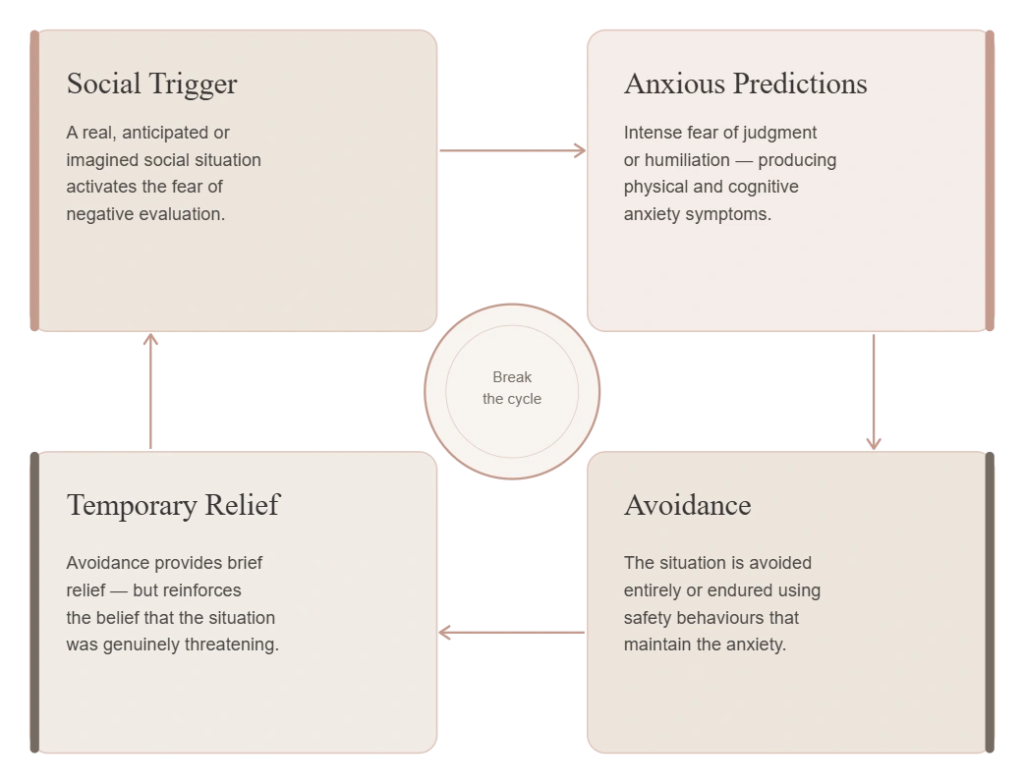
The Social Anxiety Cycle
Understanding how social anxiety maintains itself is the foundation of effective treatment.
Trigger
A social situation — real, anticipated or imagined — activates the fear of negative evaluation. The threat feels immediate and certain even when objectively unlikely.
Anxiety Response
Intense anxiety produces physical symptoms — blushing, sweating, trembling, racing heart — that are themselves feared as visible signs of inadequacy, compounding the anxiety further.
Avoidance or Safety Behaviours
The situation is avoided entirely or endured using safety behaviours — speaking quietly, avoiding eye contact, rehearsing what to say — that maintain the belief that disaster was only narrowly averted.
Temporary Relief & Reinforcement
Avoidance provides immediate relief — but reinforces the belief that the situation was genuinely dangerous and that anxiety was only managed through avoidance. The cycle strengthens with each repetition.
Treatment
Evidence-based treatment that targets the social anxiety cycle directly.
Social anxiety is highly treatable with Cognitive Behavioural Therapy — the gold standard treatment with a strong evidence base. CBT for social anxiety addresses the beliefs, predictions and behaviours that maintain the anxiety cycle — developing more accurate and balanced ways of thinking about social situations and gradually reducing avoidance through structured exposure.
Exposure work is carefully paced and collaborative — never pushing faster than you are ready to go. Safety behaviours are gradually reduced as confidence builds. Biofeedback is integrated to support nervous system regulation — helping you develop the physiological capacity to tolerate social anxiety without avoidance.
Treatment addresses not just the anxiety itself but the broader impact social anxiety has had on your life — the relationships not pursued, the opportunities not taken, the isolation that has accumulated over time. Recovery from social anxiety opens up life in ways that extend far beyond simply feeling less anxious in social situations.
What to expect
Treatment begins with a thorough assessment of your social anxiety — its history, triggers, avoidance patterns and impact on your life. From there therapy is structured, collaborative and goal-oriented — with clear explanation of the treatment rationale and regular review of progress.