
Obsessive Compulsive Disorder
Reclaiming your life from OCD.
What is OCD?
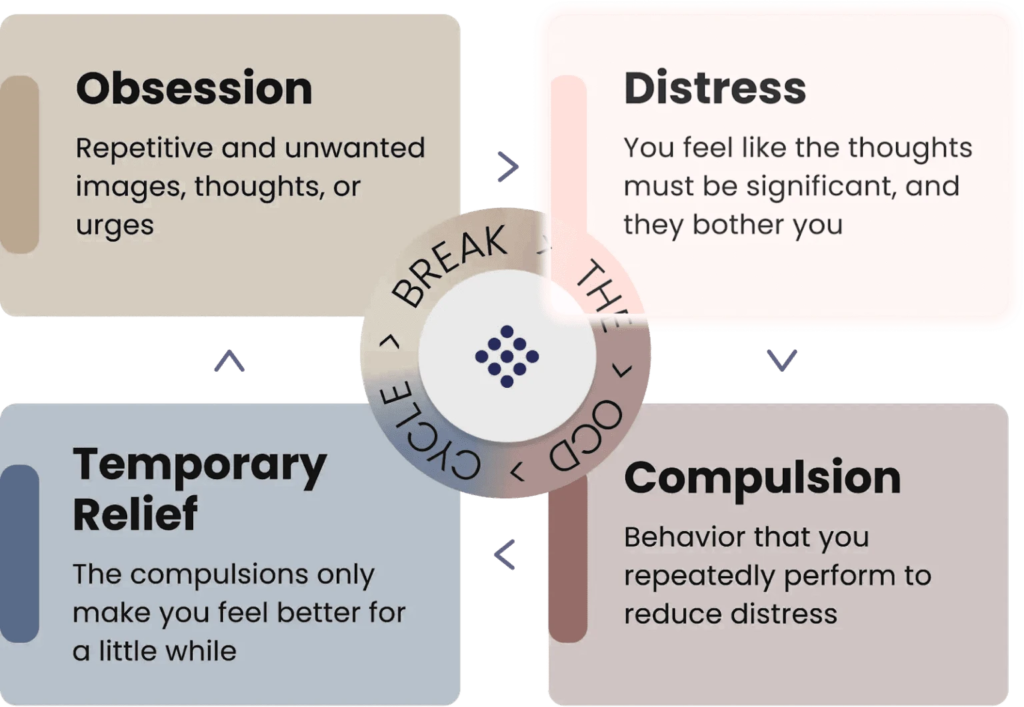
Obsessive Compulsive Disorder is a condition characterized by persistent, intrusive and unwanted thoughts, images or urges, known as obsessions, that cause significant distress, and repetitive behaviours or mental acts, known as compulsions, performed to reduce that distress. The relief provided by compulsions is temporary, and the cycle of obsession and compulsion typically intensifies over time without effective treatment.
OCD is frequently misunderstood and misrepresented. It is not about being neat, organized or particular. It is a serious and often debilitating condition that can take many forms – many of which bear little resemblance to the stereotypes. Intrusive thoughts in OCD are ego-dystonic – they feel foreign, repugnant and deeply distressing rather than reflecting the person’s actual desires or values.
At Karasick Psychology we provide evidence-based assessment and treatment for OCD in adolescents and adults, including those who have struggled for years without an accurate diagnosis or effective treatment.
The OCD Cycle
OCD Presentations
OCD can present in many different ways, many of which are not widely recognized as OCD.
Contamination
Contamination OCD involves intense fear of being contaminated — physically or mentally — and the distress and impairment that results from compulsive efforts to achieve cleanliness or safety. Mental contamination is a subtype where the feeling of being dirty comes from internal experience rather than physical contact.
Obsessions
▪ Fear of contamination by germs, illness or chemicals
▪ Mental contamination — feeling dirty or tainted from thoughts, memories or interactions rather than physical contact
▪ Fear of spreading contamination to others
Compulsions
▪ Excessive handwashing or showering
▪ Avoiding touching surfaces, objects or people perceived as contaminated
▪ Cleaning rituals performed repeatedly until they feel right
▪ Seeking reassurance about contamination
Symmetry & Ordering
Symmetry and ordering OCD is driven by an intolerable sense of discomfort or incompleteness when things are not arranged just right — not a preference for neatness but an overwhelming need for things to feel correct that can consume significant time and energy.
Obsessions
▪ Intolerable sense of discomfort or incompleteness when things are not symmetrical or ordered
▪ Fear that something bad will happen if things are not arranged correctly
▪ Need for things to feel just right
Compulsions
▪ Arranging, ordering or aligning objects repeatedly
▪ Repeating actions until they feel symmetrical or correct
▪ Counting or touching things in specific sequences
▪ Inability to leave a space until everything feels right
Checking
Checking OCD involves persistent doubt and uncertainty about whether something has been done correctly or safely — driving repetitive checking behaviours that provide only temporary reassurance before the doubt returns.
Obsessions
▪ Fear of having caused harm or made a dangerous mistake
▪ Doubt about whether something was done correctly
▪ Fear that failure to check will result in catastrophe
Compulsions
▪ Repeatedly checking locks, appliances, switches or doors
▪ Checking emails, messages or work for errors repeatedly
▪ Retracing routes to check for accidents
▪ Seeking reassurance from others that nothing bad happened
Hoarding
Hoarding OCD involves obsessional fear about discarding possessions — driven by anxiety rather than attachment. It is distinct from hoarding disorder and responds to OCD-specific treatment targeting the underlying obsessional fear rather than the hoarding behaviour itself.
Obsessions
▪ Fear of losing something important or needed in the future
▪ Sense of responsibility for objects — feeling wrong to discard them
▪ Significant distress at the thought of throwing things away
Compulsions
▪ Acquiring and keeping objects regardless of their actual value
▪ Inability to discard possessions despite wanting to
▪ Organising or checking possessions repeatedly
▪ Avoidance of situations requiring discarding of items
Intrusive Thoughts
Intrusive thought OCD involves unwanted thoughts, images or urges that feel repugnant, shameful or deeply contrary to personal values. The content is ego-dystonic — it does not reflect the person’s actual desires, beliefs or intentions. Shame and secrecy frequently delay help-seeking. Intrusive thought OCD may center around several themes.
▪ Harm OCD — intrusive thoughts about harming oneself or others, fear of acting on violent impulses or fear of being a dangerous person
▪ Scrupulosity — obsessional focus on religious or moral perfectionism, fear of sinning, blasphemy or being a fundamentally bad person
▪ Sexual OCD — distressing intrusive thoughts, images or urges of a sexual nature that feel repugnant and contrary to values
▪ Pure O — primarily mental compulsions rather than behavioural rituals — reviewing, neutralising, suppressing — frequently unrecognised as OCD
Compulsions
▪ Mental reviewing and analysing of the intrusive thought
▪ Attempting to suppress or neutralise the thought
▪ Seeking reassurance that the thought doesn’t reflect true desires
▪ Avoiding situations, objects or people that trigger the thoughts
▪ Confessing thoughts to seek reassurance
Other Presentations
OCD can present in many other ways beyond the most commonly recognised types. The following presentations are less widely known but equally valid and equally deserving of effective treatment.
▪ Relationship OCD — persistent doubt about feelings, attraction or compatibility in relationships
▪ Health OCD — obsessional fear of having or developing a serious illness despite medical reassurance
▪ Existential OCD — intrusive philosophical doubt about reality, existence or the meaning of life
▪ False Memory OCD — obsessional doubt about whether a feared event actually happened
Treatment
Evidence-based treatment that breaks the OCD cycle.
The gold standard treatment for OCD is Cognitive Behavioural Therapy with Exposure and Response Prevention — CBT-ERP. ERP involves gradual, systematic exposure to obsession-triggering situations while resisting the compulsive response — breaking the cycle of obsession, anxiety and compulsion at its core.
ERP is not about eliminating intrusive thoughts — which is neither possible nor the goal. It is about changing your relationship with those thoughts — reducing their power, their believability and the distress they cause. Over time the obsessions lose their grip and the compulsions become unnecessary.
At Karasick Psychology treatment is paced carefully and collaboratively — never pushing faster than you are ready to go. Biofeedback is integrated to support nervous system regulation during the exposure process, building the physiological capacity to tolerate distress without resorting to compulsions.
What to expect
Treatment begins with a thorough assessment of your OCD — its triggers, presentations, history and impact. From there therapy is structured, goal-oriented and evidence-based — with clear explanation of the treatment rationale and regular review of progress.